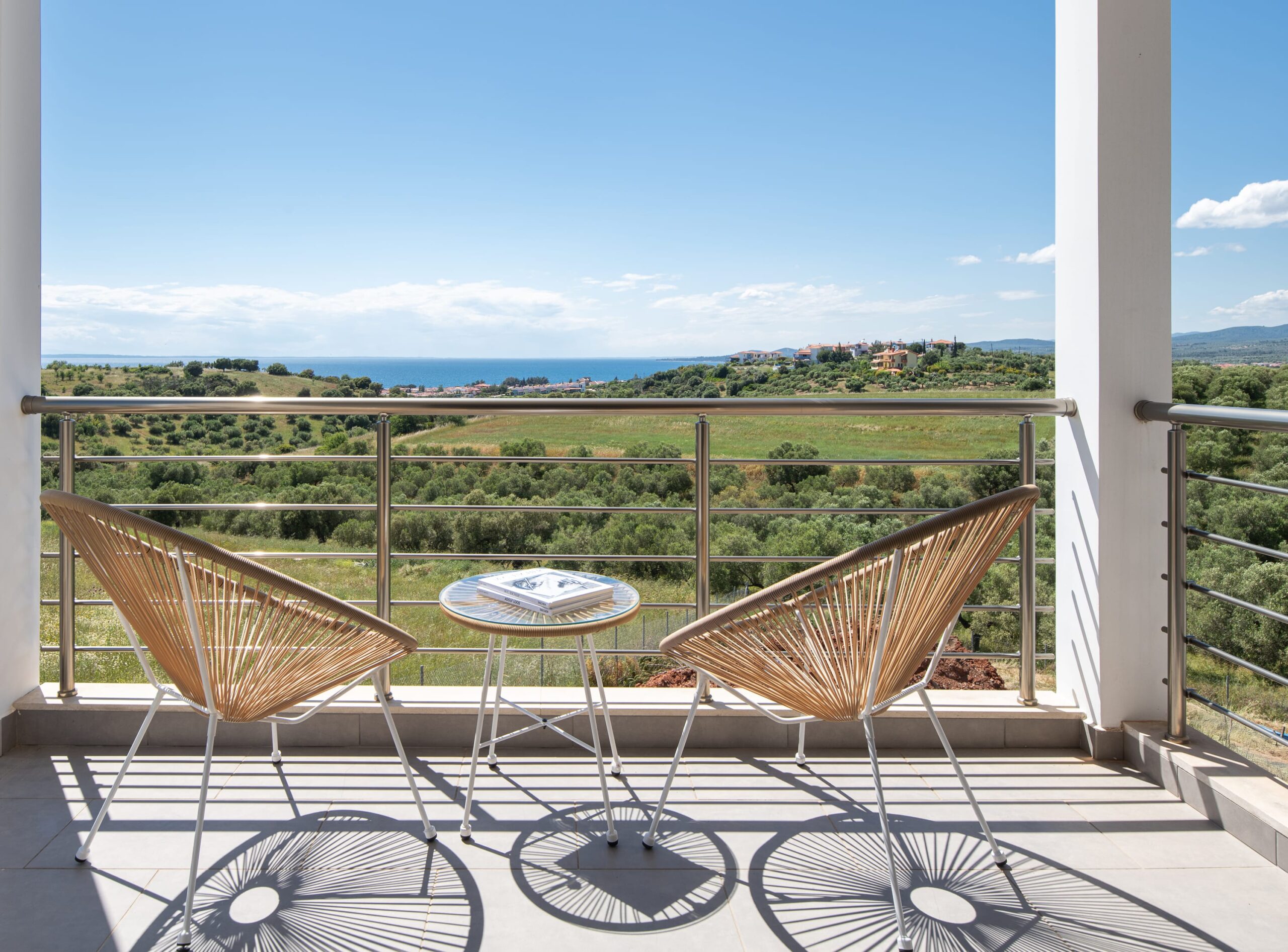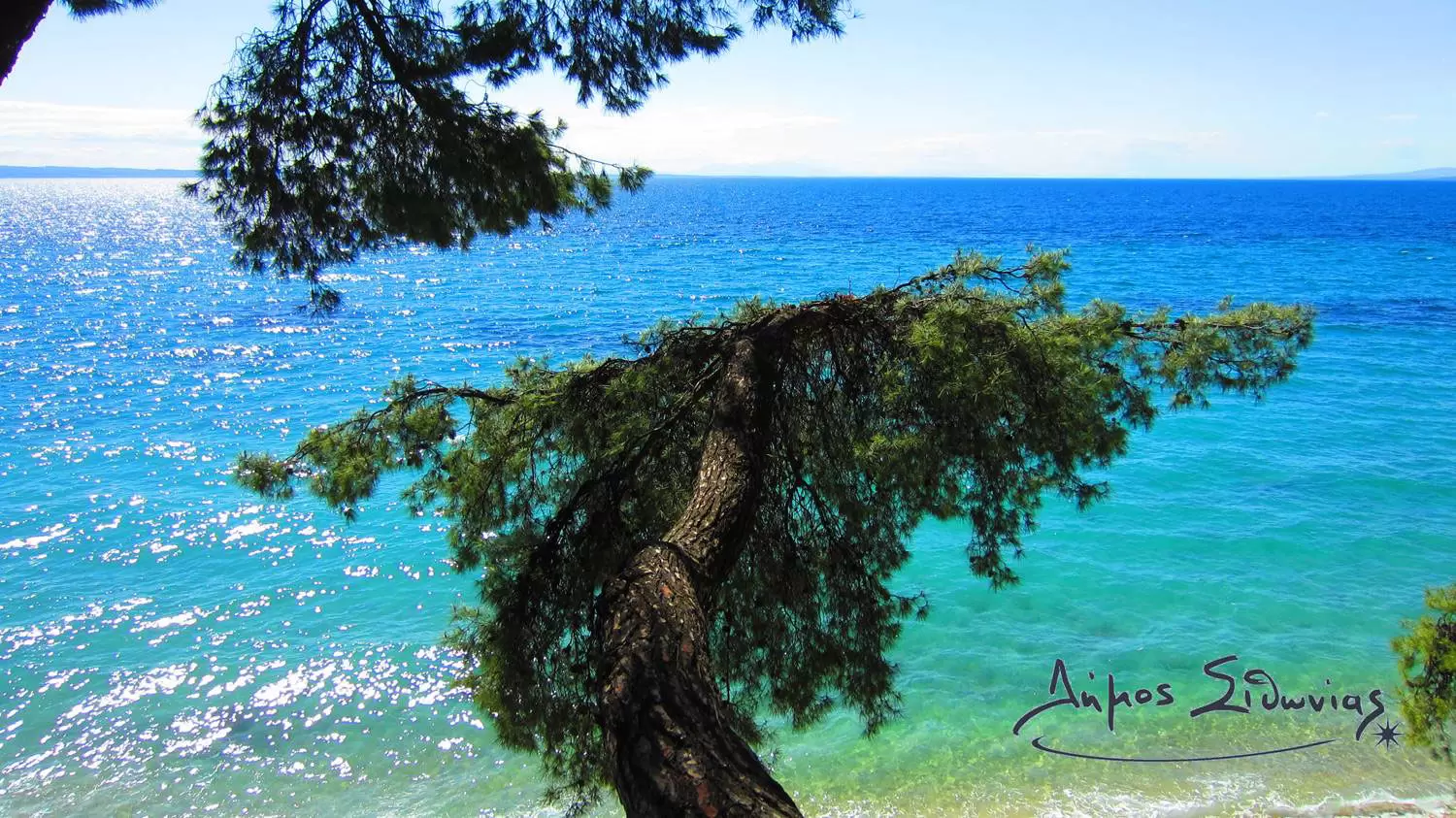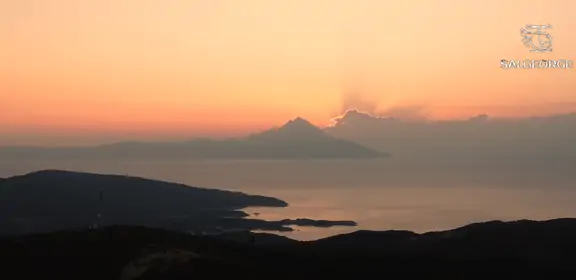
Sithonia is a peninsula of the prefecture of Halkidiki and is the so-called middle peninsula of the prefecture’s three. The peninsula of Sithonia is characterized by picturesque areas with strong relief and its organized or isolated beaches, as well as pine forests that characterize its landscape.
Geography
The peninsula is surrounded by the Gulf of Sigitikos to the east (now known as the Gulf of Mount Athos) and the Gulf of Toroneos to the west (now known as the Gulf of Kassandra). The mountain Itamos is located in the center of the peninsula. Among the many places in Sithonia are the ancient city, the castle and the church of Agios Athanasios in Toroni, the windmills in Sykia and the 16th century church in Nikiti. Nikiti is also the seat of the municipality of Sithonia. Porto Koufo is the largest bay and the most naturally safe harbor in Greece, mentioned by Thucydides. The largest settlement is Neos Marmaras, which is located in the middle of the peninsula and is the main commercial center of the area. There is also the large hotel unit of Porto Karras. At the heart of the peninsula is the area of Kartalia, where some of the most famous beaches are located, such as Azapiko, Tristinika, Korakas, Marathias, Kalamitsi, Kriaritsi, etc. On the other side we find the semi-mountainous settlement of Sykia with its beach, the touristic Sarti, Vourvourou and Ormos Panagias, located at the beginning of the peninsula.
Protected site
The greater part of the peninsula, from Vourvourou to the southern tip, with a total area of 233.34 sq km, is a protected habitat of Natura 2000. The vegetation includes mainly pine and black pine forests in the central highlands area, while the lowlands have bushy vegetation (phrygana). The area is important for the migration and breeding of several protected bird species, including cormorants, ospreys, ospreys, golden eagles, yellow-billed grebes and vlachs.
Archaeological sites
Ancient Toroni – Likythos Castle
Toroni is located in the SW. tip of the Sithonia peninsula. The port of Toroni is located east of Likythos, the small cape that today rises 13 meters above sea level, to the north of the ancient city.
The most important excavations took place in 1975. The city was colonized by the Chalcidians at the end of the 8th century BC. In 480 BC we necessarily joined Xerxes in his campaign against S. Greece. After the Media, he joined the First Athenian Alliance. She defected in 424 BC and joined Brasidas, the Spartan general, but throughout the Peloponnesian war she was the bone of contention between the Athenians and the Lacedaemonians, which is why Thucydides often mentions her.
In 348 BC it was conquered by Philip II of Macedonia. In 168 BC, after the battle of Pydna and the destruction of the Macedonian kingdom, it was occupied by the Romans. The ancient city was one of the largest and richest cities of Halkidiki.
During the first Byzantine period the city shrank. In the 14th century AD, its general area was already part of the monasteries of Mount Athos.
During the classical period, the city had two citadels, one in the south, almost at its highest point, and another at Lykythos, on the small fortified peninsula near its port. Lykythos was fortified both in the Roman and Byzantine years.
The city’s fortifications – towers of a certain height and walls – were preserved in good condition until the end of the last century, when their material was used as cobblestones to pave the streets of Constantinople and Thessaloniki. Today some traces of their foundations are visible.
Prehistoric settlement in Vetrino
The first inhabitants lived in the area of Vetrino in 5000 BC. about. Today the fortification sections of the acropolis and the ancient settlement are preserved. During 2000 BC. an increase in the local population is observed and can be seen from the creation of new neighboring settlements, such as in the areas of Mytari, Karydi of Vourvourous and the island of Diaporos. From Vetrynos one can admire a unique view of the entire region, from Toroneos to the Sigitiko gulf.
Tower of Agios Nikolaos
In the Tower of Agios Nikolaos, a prehistoric settlement developed on a small rocky peninsula, similar to Lykythos in Toroni. The settlement developed in the classical years into a city, which was probably the ancient Siggos, from which the Sigitikos gulf took its name. Sigos was a Chalcidian colony. Mentioned by Herodotus among the cities recruited by Xerxes. After the Media, he became a member of the Athenian Alliance. Its inhabitants took part in the colonization of Olynthos, but after the peace of Nicaea (421 BC) they returned and settled again in their homeland. From preliminary archaeological observations it appears that the city also existed in the Hellenistic years. Today, the loading docks are clearly visible from the ancient city loading and unloading on the north coast of the peninsula.
The 14th c. the monastery of Agios Nikolaos Chrysokamaros was built on the peninsula, which was part of the Xenophon monastery. The tower (from which the area takes its name) and the foundations of the cells on the ridge of the peninsula are preserved from the building complex.
Prehistoric mound in Kriaritsi
In the area of Kriaritsi, Sykia, a prehistoric mound was discovered. It dates from the late middle to late phase of the Early Bronze Age (ca. 2,300 – 1,900 BC). This artificial cover covered 30 tombs with circular enclosures, each of which contained vessels with the ashes of the dead. The importance of the find lies in its uniqueness for the area of Macedonia, as it enriches our knowledge of burial habits and the methods of construction of burial mounds during the Bronze Age.
Prehistoric settlement at “Koukos” site
To the west of Sykia is the “Koukos” hill. It is a steep, rocky and high hill, which dominates Sykia and its area. The summit plateau is surrounded by a castle, where there was an important prehistoric settlement. Excavations by archaeologists have shown that the area has been inhabited since the 11th century BC. and the habitation is probably due to the rich sources of copper that began to exploit them from the Middle Bronze Age.
Basilica of Sophronios
Early Christian Church in the area of Agios Georgios of Nikiti. The temple came to light with excavations that began in 1981 a few meters west of the current chapel of Agios Georgios near the beach of Nikiti. The church dates from the first half of the 5th century AD and is one of the oldest early Christian churches that has been found in the region of Macedonia. It is a three-aisled basilica with a wooden roof with a total length of 48m. An inscription found during the excavation mentions the name “Sophronios” as a bishop of the time. Thus the temple was named “basilica of Sophronius”.
The exquisite decoration of the temple, the mosaics of the floor, as well as the finds in the neighboring cemetery, where two vaulted tombs were found, reinforce the belief that there were important people in the area who could allocate money for the construction of the temple.
Evidence shows that the temple was destroyed by fire in the 6th century AD. On the other hand, the archaeological finds in the wider area of the settlement seem to be no newer than the 6th century AD. Around the same period, a neighboring settlement in the area of Elia must have been destroyed. Thus, one can be led to the conclusion that the settlement, like the temple, was destroyed by raids by barbarian tribes that were frequent at that time in the area of Halkidiki and Macedonia in general. Another theory claims that the temple was destroyed by an earthquake.
Early Christian basilica of Agios Georgios
The chapel of St. Georgiou is built on the middle aisle of a three-aisled early Christian basilica church of the 5th century AD, measuring 14×12.5 meters, which was probably destroyed in the 6th century AD. along with the most important settlement of the time. The settlement began to appear in the Hellenistic years (3rd-2nd century BC) and developed rapidly on the hills north of Ag. Georgiou. An inscription found in 1963 embedded in the chapel of St. Georgiou, gave us important information. According to her text, Heraclides and Menippus, the children of a certain Phanius, dedicated something to the Dioscuri and Manda, who heard their prayer.
The early Christian basilica on which the chapel is built today, according to the findings of the 1971 excavation that we see today, was a beautiful church, which was divided into three aisles, with three pairs of marble columns and had a finely worked marble altarpiece. To the southeast of the church was the cemetery of the then settlement, from which two large, brick, vaulted tombs were found. With the excavations of 1979, a Roman bath was also discovered, which may have been used as a baptistery.
Early Christian Church of Agios Athanasios
In the area of Toroni is the early Christian church of Agios Athanasios. It was built in the 5th century and is a three-aisled basilica. It was destroyed by fire in 6 AD. century and another temple was built in its footsteps, which was also destroyed. Today the mosaic of the middle aisle is preserved in good condition.
NEWER MONUMENTS
Sykia Windmills
Two windmills in the municipal community of Sykia dating back to 1890 are classified as historical monuments. A 20-meter protection zone has been defined around them, because they are notable monuments of popular architecture that are interesting from a building, architectural and morphological point of view and are inextricably linked to the history of the area.
Windmills in Nikiti
Two windmills in Nikiti Halkidiki are classified as historical monuments and a protection zone with a radius of 50 meters is defined around them, because they are buildings of the first half of the 19th century and are of interest in terms of construction and morphology of the place and are inextricably linked to the history of the area .
Roller mill of Mantsios in Nikiti
Roller mill of Mantsios on the beach of Nikiti Halkidiki with its surrounding area at the property limits is characterized as a historic preserved monument that needs special state protection, for social reasons and as a remarkable example of technical culture. It is a complex of three stone-built, tile-roofed buildings of different heights, which are arranged in a row. The building complex of the Manchiou flour mill was built in the interwar period and is an important testimony of the evolution of traditional windmills into flour mills with internal combustion engines.
Old Primary School in Nikiti
Next to the Church of Agios Nikitas in the settlement of Nikitas, is the Old Primary School. It is a preserved stone building of traditional Macedonian architecture, dating back to 1870. Today it houses the Folklore Museum.
Old Primary School in Sykia
In the center of the village dominates the magnificent old school of Sykia, Macedonian architecture with stone columns, built in 1870.
Source: https://www.halkidikiguide.com/